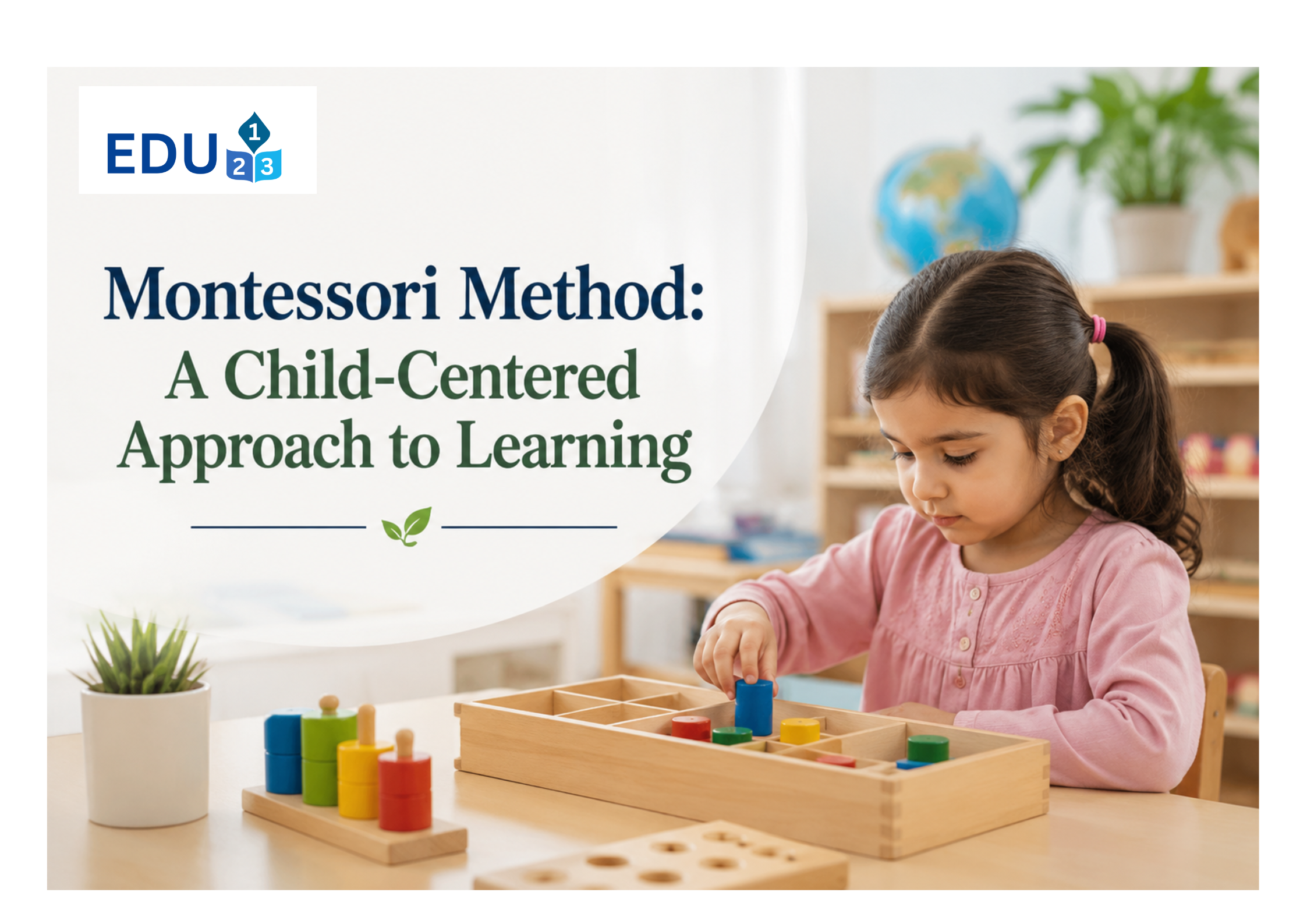

The Montessori Method has shaped the way millions of children learn, explore, and grow since its creation over a century ago. Unlike traditional classrooms that rely on rigid instruction, the Montessori Method places the child at the center of the learning experience, encouraging curiosity, independence, and self-paced discovery. For parents researching schooling options in India, understanding how this approach works can make all the difference when choosing the right environment for a young learner. In this article, we will explore the philosophy, benefits, classroom structure, and practical applications of the Montessori Method, along with how it compares to conventional education systems.
What Is the Montessori Method?
The Montessori Method is an educational approach developed by Dr. Maria Montessori in the early 1900s, rooted in the belief that children learn best through hands-on experience and self-directed activity. Rather than following a fixed curriculum delivered by a teacher at the front of the room, this method allows children to choose activities that match their interests and developmental stage. The result is a learning environment where exploration, not memorization, drives progress.
At its core, the Montessori Method is built on respect for a child’s natural psychological development. Classrooms are designed with specially crafted materials that children can touch, manipulate, and learn from directly. Boarding schools in Bengaluru Teachers, often called guides, observe each child closely and offer support only when needed, allowing independence to flourish naturally.
Core Principles Behind the Montessori Method

Several foundational ideas distinguish this approach from conventional schooling. Understanding these principles helps explain why so many parents and educators continue to embrace it today.
Child-Led Learning
One of the most distinctive features of the Montessori Method is its emphasis on child-led learning. Instead of a teacher dictating what happens next, children select their own activities from a range of options prepared in advance. This freedom, paired with structure, nurtures intrinsic motivation rather than learning driven purely by grades or rewards.
Hands-On, Sensory Materials
Classrooms following this method use specially designed materials, such as wooden puzzles, counting beads, and textured letters, that allow children to engage multiple senses while learning abstract concepts. As a result, lessons in math, language, and science become tangible rather than theoretical.
Mixed-Age Classrooms
Most Montessori settings group children across a three-year age span rather than by a single grade level. Younger children learn by observing older peers, while older children reinforce their own understanding by mentoring younger classmates. This dynamic builds social skills alongside academic ones.
Benefits of the Montessori Method for Children
Parents often ask what sets this educational philosophy apart in practice. The benefits tend to fall into a few key categories that influence both academic outcomes and personal growth.
- Encourages independence and self-discipline through self-directed tasks
- Builds strong problem-solving skills via hands-on exploration
- Supports individual learning pace instead of forcing uniform progress
- Nurtures a genuine love of learning rather than rote compliance
- Strengthens social-emotional development through mixed-age collaboration
- Promotes concentration and focus through uninterrupted work periods
Because the Montessori Method emphasizes real-world skills, such as pouring, sorting, and organizing, children often develop fine motor coordination earlier than peers in traditional settings. Additionally, since each child works at their own pace, those who need more time with a concept are not rushed, while quicker learners are not held back.
Montessori Method vs Traditional Classroom Approach
To better understand how this child-centered model differs from conventional schooling, the comparison below highlights some of the most notable distinctions.
| Aspect | Montessori Method | Traditional Classroom |
| Learning Pace | Self-paced, individualized | Fixed pace set by curriculum |
| Teacher’s Role | Guide and observer | Primary instructor and lecturer |
| Classroom Structure | Mixed-age groups | Single-grade classrooms |
| Materials | Hands-on, sensory-based tools | Textbooks and worksheets |
| Assessment | Observation-based, minimal testing | Frequent tests and grades |
| Student Choice | High, child selects activities | Low, teacher-directed schedule |
This comparison shows why many families exploring alternative education models are drawn to Montessori-style learning, particularly for younger children who benefit from exploratory, low-pressure environments.
How the Montessori Method Supports Long-Term Development
Beyond the early years, the principles instilled through this approach often carry into adolescence and adulthood. Children who grow up with this style of education frequently demonstrate stronger time-management skills, since they have practiced organizing their own work from a young age. Furthermore, because collaboration and respect for others are built into daily classroom routines, many students develop strong interpersonal abilities that serve them well later in group projects, leadership roles, and community involvement.
It is also worth noting that the Montessori Method is not limited to early childhood. While most commonly associated with preschool and primary years, Montessori-inspired programs extend through adolescence in some schools, adapting the same principles of independence and self-direction to more advanced academic content. This continuity allows students to retain the curiosity-driven mindset cultivated in their earliest years of schooling.
Choosing a School That Follows the Montessori Method

For parents evaluating schools, it helps to know what genuine implementation of this approach looks like in practice. Authentic classrooms typically feature uninterrupted work periods of one to three hours, specially trained guides rather than conventional teachers, and a noticeably calm, organized environment. Since the term “Montessori” is not trademarked, not every school using the name follows the original philosophy with fidelity, so it is worth asking direct questions about teacher training, classroom materials, and daily schedules before enrolling a child.
Visiting a prospective school and observing a class in session often reveals more than a brochure ever could. Look for children working independently or in small groups, low noise levels, and materials that are accessible and child-sized. These visual cues are strong indicators that a school has genuinely embraced the Montessori Method rather than simply borrowing its name for marketing purposes.
Conclusion
The Montessori Method offers a thoughtful, child-centered alternative to conventional education, built around independence, hands-on exploration, and respect for each child’s developmental pace. From mixed-age classrooms to sensory-rich materials, this approach nurtures curiosity rather than compliance, helping children become confident, self-directed learners. Whether you are comparing philosophies for the first time or refining your search for the right school, understanding the Montessori Method equips you to make a more informed decision for your child’s early education. As with any schooling choice, visiting classrooms and speaking with educators remains the best way to confirm whether a school’s practice genuinely reflects this time-tested, child-first philosophy.
Frequently Asked Questions
Q1. What age group is the Montessori Method designed for?
Ans. The Montessori Method was originally designed for children aged three to six but has since been adapted for infants, toddlers, and even adolescents in some schools.
Q2.Is the Montessori Method effective for academic achievement?
Ans. Research and long-term observation suggest children in well-implemented Montessori programs often perform comparably or better than peers in traditional schools, particularly in problem-solving and independence.
Q3. How is a Montessori classroom different from a regular classroom?
Ans. A Montessori classroom features mixed-age groups, hands-on learning materials, and child-led activity choices, while regular classrooms typically follow a fixed curriculum led by a teacher.
Q4. Do Montessori schools follow a standard curriculum?
Ans. Montessori schools follow a structured framework of materials and skill progression, but children move through it at their own pace rather than a fixed schedule.
Q5. Is the Montessori Method suitable for every child?
Ans. Most children adapt well to this approach, though those who thrive on highly structured routines may need additional adjustment time when transitioning into a Montessori setting.
Q6.How do teachers function in a Montessori classroom?
Ans. Teachers, often called guides, observe students closely and step in only when guidance is needed, rather than delivering constant direct instruction.
Q7. Can the Montessori Method be combined with boarding school education?
Ans. Yes, some boarding schools incorporate Montessori principles into their early years or junior programs before transitioning students to more conventional academic structures in later grades.
0