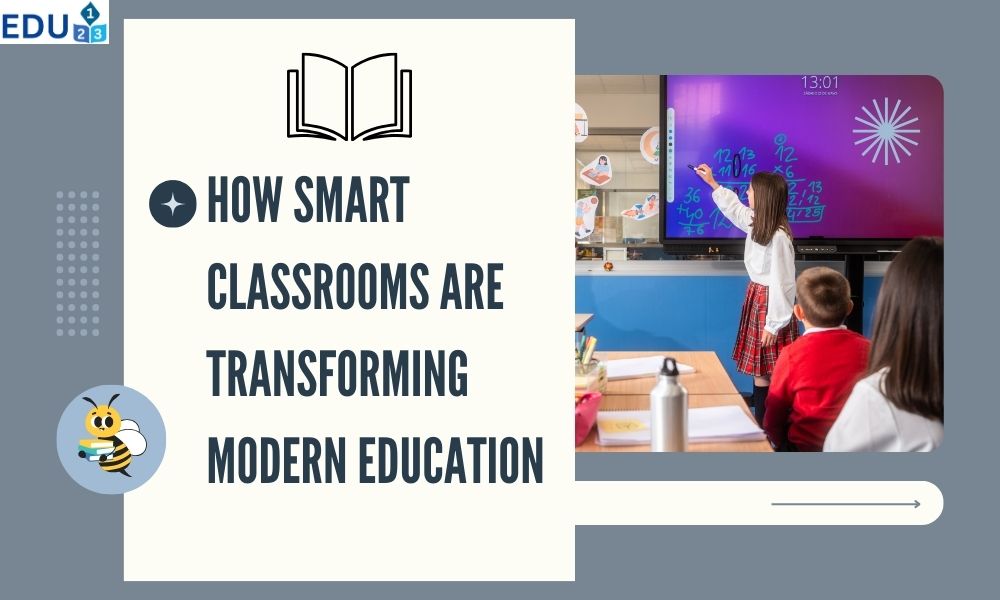

Education has continued to evolve and expand over the course of history, but transformation in the 21st century has been unprecedented. The most groundbreaking innovation may be the smart classroom, which is groundbreaking. It combines technology, interactive software, and new methods to establish productive learning spaces. Parents and students need to know how smart classrooms function and why they are crucial to educational policy.
Here, in this blog, we will talk about what they are, their advantages, most salient features, issues, and how they impact the learning process of the students.
What Are Smart Classrooms?
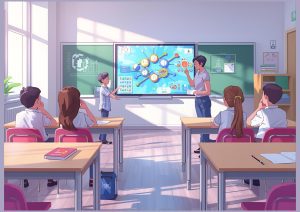
A smart classroom is an assistive learning environment that is technologically advanced with features such as interactive boards, projectors, audio-visual aids, tablets, and internet. These are superior to the chalk-and-board classrooms and offer real-time collaboration, visual learning, and individualized education.
Through the utilization of digital content, multimedia materials, and creative instructional methods, such classrooms provide an engaging and effective learning experience.
Why Smart Classrooms Are Relevant Nowadays
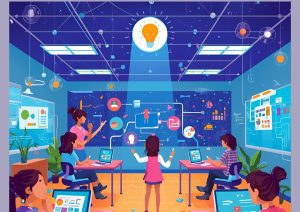
The globe on which students are being prepared today is a different one from that of their parents. Apart from rote, critical thinking skills, problem-solving capacities, information technology literacy, and collaboration, these are what they need. Intelligent classrooms fill this gap by offering learning experiences that are responsive to needs today.
To parents, it is an investment that guarantees children don’t only acquire knowledge but also skills for the future.
Major Features of Smart Classrooms
The smart classroom isn’t characterized by a single tool but by a group of technologies and methodologies. Their most noticeable characteristics are:
1. Interactive Whiteboards
Chalkboards are substituted by interactive whiteboards through which the teacher can present multimedia material, comment in real-time, and present lessons interactively.
2. E-Learning Tools and Digital Content
Videos, animations, and simulation make it easy to simplify complex ideas. For example, a science lab can be presented virtually so that it is not that hard to comprehend.
3. Cloud-Based Learning
Online assignments, notes, and presentations are uploaded, with the possibility of studying 24 hours a day, 7 days a week. This also facilitates easier remote learning.
4. Collaborative Platforms
Collaborative activities are promoted, allowing students to collaborate with one another using common digital tools in order to enhance teamwork and communication.
5. Assessment Tools
Quizzes, polls, and instant feedback enable teachers to monitor progress more easily than with traditional tests.
Advantages of Smart Classrooms
Introducing smart classrooms is not a flash-in-the-pan affair—it’s a revolution that brings real returns on investment for instructors and students.
1. Increased Engagement
Multimedia lessons engage the learner more than textbooks. Students remain engaged when learning is fun.
2. Enhanced Learning Outcomes
Evidence indicates that visual learning enhances recall. With diagrams, videos, and simulations, ideas become simpler.
3. Tailored Learning
The lessons can be tailored to match and intensity of individual students. This is especially beneficial for students who require extra support.
4. Skills for the Future Workforce
Technology-enabled learning develops digital literacy, problem-solving, and collaboration—skills necessary for today’s economy.
5. Convenience for Teachers
The teachers are able to organize lessons better, reuse material, and monitor performance through smart tools, which lightens the administrative burden.
Problems with Smart Classrooms
- While such classrooms are very helpful, they do have some problems:
- High Implementation Cost – It is costly to install digital infrastructure.
- Digital Divide – Not everybody has a device or internet connection in the home.
- Teacher Training – Teachers must be well-trained to use the technology effectively.
- Overdependence on Technology – Excessive screen time impinges on concentration and well-being.
These problems being recognized guarantee that technology will supplement learning and not substitute for human interaction.
The Impact on Students
The real success of smart classrooms is the impact they have on the students. With the interactive and dynamic setting, they:
- Cultivate curiosity and creativity.
- Ease self-directed learning.
- Enhance academic performance.
- Develop confidence through presentation and collaboration.
- Get prepared for a digital-first world.
For the parents, the benefit is seeing the child develop not just intellectually but also as an able, adaptable individual.
Future of Smart Classrooms in India

Massive adoption is being seen in India, especially among schools in cities. With efforts such as Digital India and affordable options provided by EdTech companies, even semi-urban and rural areas are being reached now.
The following generation may be educated through AI-powered personalized learning, VR-powered virtual classrooms, and analytics to monitor the journey. The synergy of technology and education promises efficient and inclusive learning for everyone.
Conclusion
Smart classrooms are no longer a luxury but a must. Integrating technology with the conventional classroom, they create a space wherein education is not just interactive, customized, and state-of-the-art but also makes students globally competitive and gives parents assurance that education is aligned with international standards. Investing in such classrooms amounts to investing in future education—a future wherein learning is not merely conveyed but lived.
FAQs on Smart Classrooms
Q1. What is a smart classroom in simple terms?
Answer- It is an IT-facilitated learning space where projectors, smart boards, and multimedia software turn lessons into interactive sessions.
Q2. What benefit does a smart classroom provide to students?
Answer- They enhance understanding, enhance concentration, and make learning fun with visual and interactive media.
Q3. Are smart classrooms superior to traditional classrooms?
Answer- They offer increased interaction, variety in learning options, and exposure to computers but function best in conjunction with conventional teaching.
Q4. Do smart classrooms substitute teachers?
Answer- No, the teachers are at the center. The technology only improves their teaching methods.
Q5. What is the future of smart classrooms in India?
Answer- With affordable EdTech and digitization, they are growing at a rapid rate and would most probably incorporate AI and VR-based learning in the future.